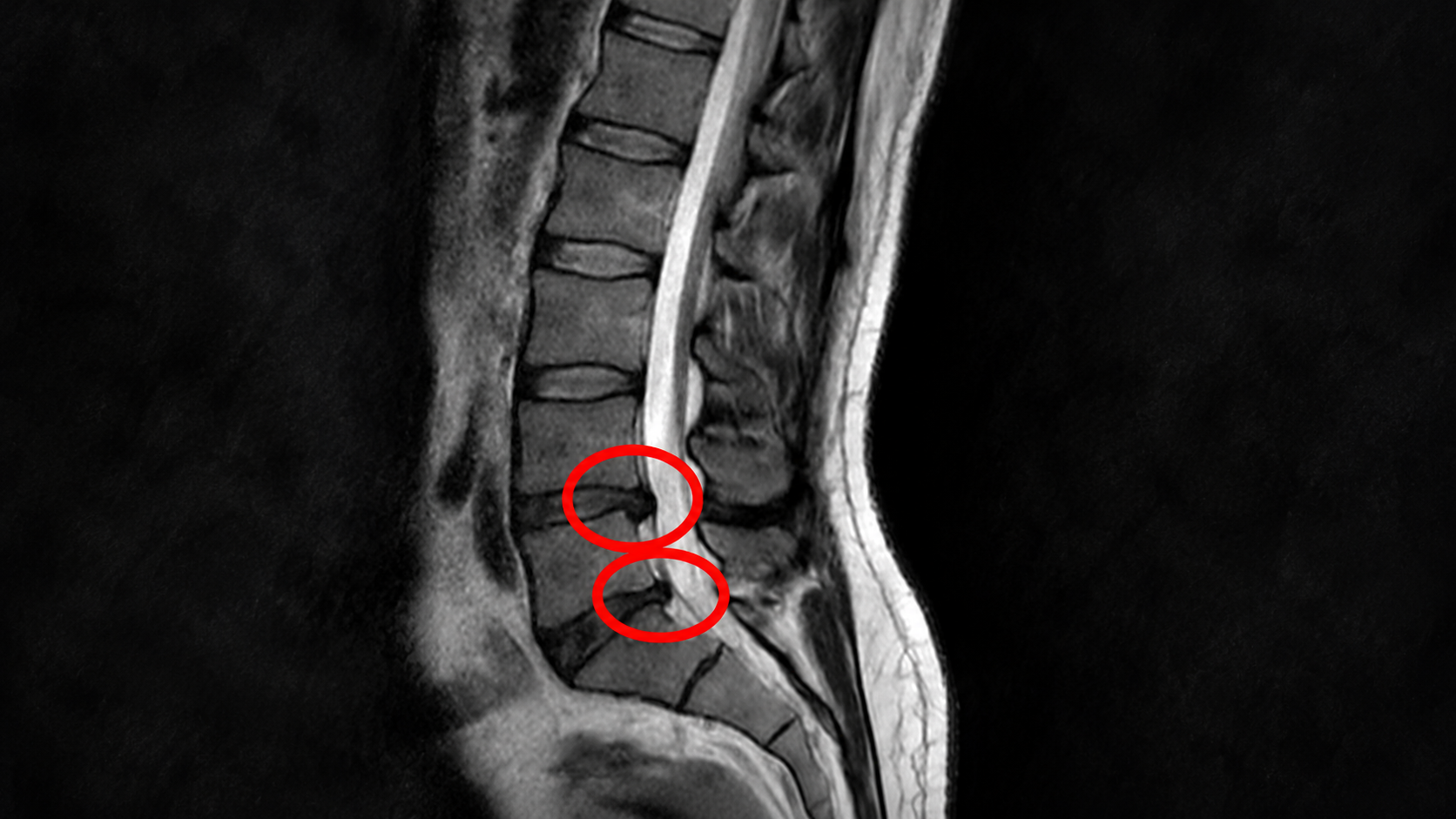
If an MRI shows a bulging disc, degeneration, or a herniation, the conclusion seems obvious: this is where the pain is coming from. Something is wrong with the back, so the back needs to be fixed.
From that perspective, the suggestion that psychotherapy could reduce or even eliminate back pain sounds almost absurd. How could changing the way someone thinks or feels alter a problem visible on a scan?
Yet one peer-reviewed study found exactly that.
In a randomized trial of 151 adults with longstanding chronic back pain, 66% of those who received Pain Reprocessing Therapy were pain-free or nearly pain-free after treatment. Much of the improvement remained one year later.
How is this possible?
The Scan Can't Tell Us the Cause of the Pain
An image can show us what is present in the spine. It cannot tell us, by itself, what is generating a person's pain.
Structural changes in the spine are extremely common, whether or not we have back pain. A systematic review of 3,110 people with no back pain found that by age 50, 80% had disc degeneration and 60% had at least one bulging disc.
This does not mean structural findings never matter. Some injuries and diseases clearly require medical treatment. But a scan is not a verdict. If the same finding appears in someone with severe pain and someone who feels perfectly well, the structural abnormality cannot be the entire explanation.
Dr. John Sarno's Alternative Treatment for Back Pain
Several decades ago, rehabilitation physician Dr. John Sarno began questioning structural explanations for persistent back pain. He saw patients whose scans showed abnormalities, sometimes dramatic ones, yet the location, timing, and behaviour of their symptoms did not match those findings.
Sarno proposed a diagnosis called Tension Myositis Syndrome (TMS). He believed repressed rage and anxiety caused the autonomic nervous system to reduce blood flow to muscles, nerves, tendons, and ligaments. The resulting mild oxygen deprivation produced pain. He also believed the pain served a psychological purpose by drawing attention away from emotions the person found too threatening to experience consciously.
His treatment was primarily educational. Patients learned about TMS, reconsidered their structural diagnoses, reflected on what was happening in their emotional lives, and resumed normal physical activity. Sarno reported that thousands of the patients he treated fully recovered with his mind-body approach, sometimes after reading his book alone.
Research since then has not established oxygen deprivation or repressed rage as the central mechanism behind persistent pain. Still, Sarno recognized something important: changing a person’s understanding of pain could change the pain itself, making it possible to recover without correcting the structural abnormalities found on a scan.
A More Modern Explanation: Pain as Protection
How can we use this knowledge to help people with chronic pain?
Sarno believed that understanding pain was itself part of the treatment. Many modern approaches to chronic pain now place education at the centre, as Sarno did, although our understanding of how pain works has changed.
Knowledge serves as fuel for recovery. Here is what newer pain science tells us:
Pain is not a direct measure of tissue damage. It is a protective experience generated by the brain and nervous system using different sources of information, which may include nociception, memory, expectations, context, and perceived danger. You can read more about how nociception works in Why Pain Doesn’t Always Mean Damage.
Our brains can continue trying to protect us even after an injury has healed and that protection is no longer necessary.
Imagine that your brain has learned to associate bending your back with danger. The sensation you feel while bending is interpreted as evidence of damage. Fear rises, so you monitor your back, brace your body, and avoid certain movements. Those responses reinforce the brain’s conclusion that your back is damaged and needs protection.
Pain produces fear. Fear produces more danger and protection. More protection produces more pain.
Over time, the nervous system can become increasingly sensitive and protective. If learned danger is maintaining the pain, the key to reducing it is changing what the brain has learned.
The Pain Reprocessing Therapy study cited earlier demonstrates this possibility. After a physician assessment and eight psychological treatment sessions, 66% of participants were pain-free or nearly pain-free, compared with 20% receiving an open-label placebo and 10% continuing their usual care.
No structural intervention was used. What changed was how their brains interpreted and responded to sensations from their backs.
Emotions Play a Key Role Too
Sarno placed rage at the centre of his theory. I think he was right to take emotion seriously, but rage is not the only emotion we learn to fear.
Consider shame. Many conscientious people will work themselves to exhaustion, ignore their own needs, focus on what everyone else needs, and try never to make a mistake. Perfectionism and people-pleasing may be attempts to avoid criticism, rejection, or the painful sense of not being good enough: shame. Others may organize their lives around avoiding grief, terror, or helplessness.
I remember how hard I worked during my own depression to avoid emotions that made me feel vulnerable and out of control. I once thought that to recover, I needed to eliminate those emotions, that I needed to become fearless and tough. Instead, healing came through learning that I could safely feel all emotions without being consumed by them.
I’m not convinced that pain is always a coded message or a deliberate distraction created by a mind with an agenda. A more helpful possibility is that pain is the brain’s way of alerting us to danger. That danger might be immediate and physical, or it might be more complex and persistent, for example, when someone is living in chronically stressful circumstances involving family, romantic, or work relationships, or dealing with the effects of trauma. In these cases, emotions may serve as danger signals, alerting us that our needs for safety are not being met and that something needs to change.
Repressing emotional signals doesn’t relieve the underlying danger. It’s like turning off a smoke alarm when there’s still a fire. When we “turn off” emotional signals, perhaps the unresolved danger is expressed in the body instead: either because pain becomes an alternative way of signalling danger or because the brain has learned to interpret the emotions themselves as dangerous. In either case, learning to feel those emotions without becoming overwhelmed can help reduce the brain’s need for protection.
This may help explain why Sarno’s educational approach, which encouraged people to think about what was making them angry or anxious rather than continually monitoring their physical symptoms, could relieve physical pain.
A Different Path to Recovery
A mind-body approach must still begin with a careful assessment. Is there an injury, disease, or structural problem requiring medical treatment? Do the symptoms behave as we would expect if ongoing tissue damage were the main cause?
When the evidence suggests that learned danger and protective responses are maintaining the pain, treatment can focus on changing those processes. This may involve understanding how pain works, reconsidering beliefs about damage, approaching sensations and movement differently, and becoming more able to experience difficult emotions.
You do not have to accept every mind-body explanation to make progress. If the condition of the spine does not explain the pain, recovery should not have to depend on fixing the spine.
The way out of pain can begin with helping the brain and body learn that protection is no longer needed.
References
Ashar, Y. K., Gordon, A., Schubiner, H., et al. (2022). Effect of Pain Reprocessing Therapy vs placebo and usual care for patients with chronic back pain: A randomized clinical trial. JAMA Psychiatry, 79(1), 13–23. doi:10.1001/jamapsychiatry.2021.2669.
Brinjikji, W., Luetmer, P. H., Comstock, B., et al. (2015). Systematic literature review of imaging features of spinal degeneration in asymptomatic populations. American Journal of Neuroradiology, 36(4), 811–816. doi:10.3174/ajnr.A4173.
Sarno, J. E. (1991). Healing back pain: The mind-body connection. Warner Books.